

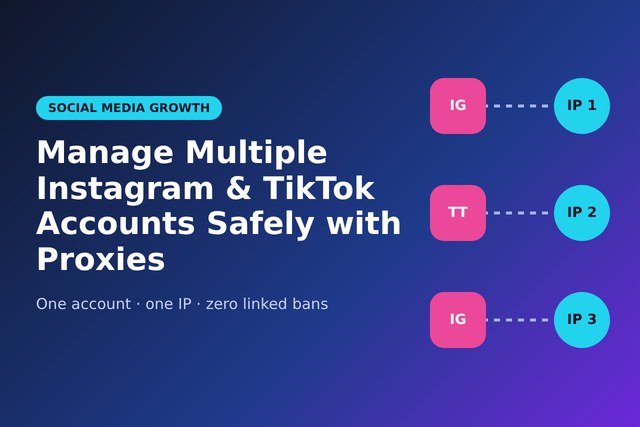
If you grow Instagram or TikTok profiles seriously, you probably run more than one account. Maybe it’s a personal profile plus a brand page, a few client accounts, or a handful of niche pages you’re testing. Sooner or later you hit the same wall everyone hits: logins get flagged, accounts are asked to verify again and again, and sometimes several profiles get restricted at the same time. In most cases, the problem isn’t your content. It’s your IP address.
In this guide, we’ll explain why social platforms watch IP addresses so closely, which types of proxies actually work for social media, and how to set them up so every account looks like it’s run by a separate, real person.
Table of Contents
Why Instagram and TikTok Care About Your IP Address
Every time you log in, the platform records a set of signals: your device, browser fingerprint, location, and IP address. When ten different accounts log in from the same IP within a few minutes, the algorithm sees a clear pattern. It doesn’t matter that each account has different photos and captions, from the platform’s point of view, they’re all connected.
Once accounts are linked, a penalty on one of them can spread to the others. That’s why people who manage many profiles often lose several at once. Separating accounts by IP is the first and most important step toward keeping them safe.
What a Proxy Does for Multi-Account Management
A proxy server sits between your device and the internet. Instead of the platform seeing your real IP, it sees the proxy’s IP. By assigning a different proxy to each account, you give every profile its own “home address,” so the accounts no longer look connected.
Not every proxy is a good fit, though. Free public proxies are shared by thousands of users, are often already blacklisted, and can be slow or unsafe. For social media work you need a provider with clean IPs, stable connections, and enough location options. A good example is online proxy ukraine, a Ukrainian provider that offers datacenter, residential, mobile, and ISP proxies with HTTP, HTTPS, SOCKS4, and SOCKS5 support, so you can pick the right type for each task instead of forcing one solution onto everything.
Choosing the Right Proxy Type for Social Media
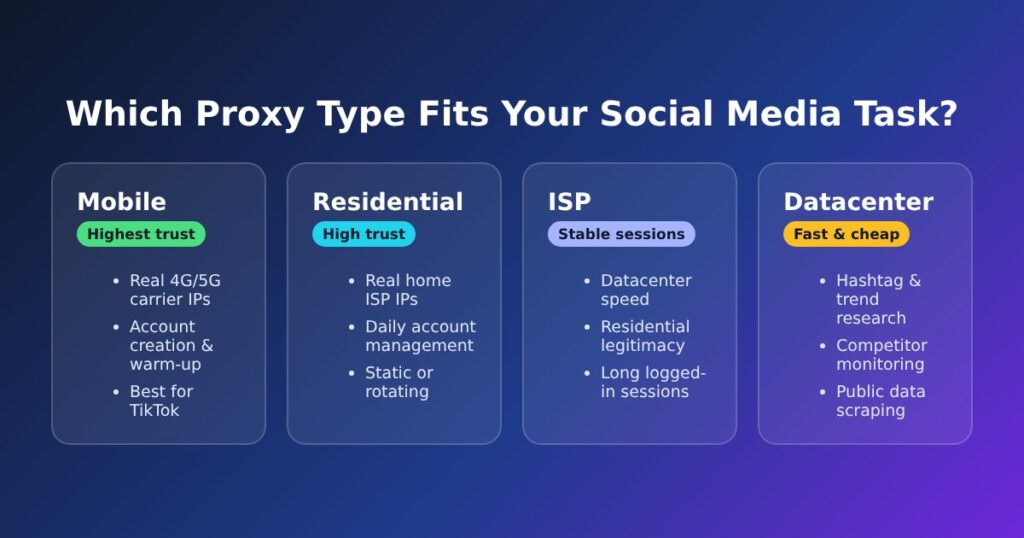
Mobile Proxies: The Safest Option for Instagram and TikTok
Mobile proxies route your traffic through real mobile carrier networks (3G/4G/5G). Since Instagram and TikTok are mobile-first apps, traffic from a mobile IP looks completely natural. Carriers also share one IP among many real users, so platforms are very careful about blocking these addresses. For account creation, warming up new profiles, and daily activity, mobile proxies are usually the most reliable choice.
Residential Proxies: Real Home Connections
Residential proxies use IPs that internet providers assign to ordinary households. They carry a high level of trust and are a strong option for running established accounts. A fixed (static) residential IP is ideal when you want one account to always appear from the same location, while rotating residential proxies work well for research and data collection.
Datacenter Proxies: Fast and Budget-Friendly
Datacenter proxies are fast and cheap, but their IPs belong to hosting companies, which platforms recognize more easily. They are less suited to logging into social accounts, but they’re great for supporting tasks like checking hashtags, monitoring competitors, scraping public profile data, or testing how your content appears in other regions.
ISP Proxies: The Middle Ground
ISP proxies combine the speed and stability of a datacenter with the legitimacy of a residential IP. They’re a good choice if you need long sessions on the same account without the IP changing.
How to Set Up Proxies for Multiple Accounts
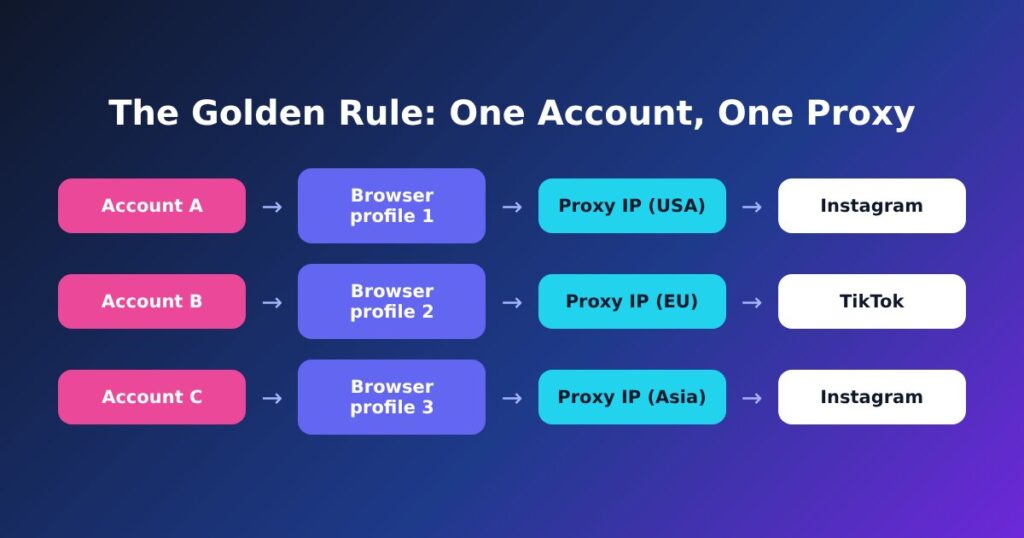
- Follow the one account, one IP rule. Never share a single proxy between several social profiles. Each account should have its own dedicated IP.
- Use an antidetect browser. Tools like AdsPower, GoLogin, or Multilogin create a separate browser fingerprint for each profile. Pair every browser profile with its own proxy for complete separation.
- Match the location. If your audience is in the US, use US IPs. If you target Europe or Asia, choose proxies in those regions. A sudden jump between countries is a red flag for the algorithm.
- Keep IPs stable for logged-in accounts. Use static proxies or long rotation intervals for accounts you’re logged into. Fast rotation is better saved for scraping and research.
- Warm up new accounts slowly. Even with a perfect proxy, a brand-new account that follows hundreds of people on day one will look suspicious. Increase activity gradually over the first weeks.
What to Look for in a Proxy Provider
Before you buy, check these points:
- Clean IP pool: IPs that aren’t already banned on major platforms.
- Protocol support: HTTP(S) and SOCKS5 cover nearly every app and antidetect browser.
- Flexible plans: the option to rent for a day, a week, or a month, so you can test before committing.
- Fast replacement: if a proxy stops working, it should be replaced quickly.
- Responsive support: 24/7 help matters when an account is in the middle of a campaign.
- Convenient payment: card, crypto, or PayPal options make things easier for international users.
Common Mistakes That Still Get Accounts Flagged
Proxies solve the IP problem, but they can’t fix bad habits. Avoid logging into several accounts from the same phone app without separation, switching proxies on an account every day, using free proxy lists for logins, and running aggressive follow/unfollow automation. Platforms look at behavior as much as technical signals, so natural, consistent activity is still essential.
Frequently Asked Questions
Are proxies legal to use for social media?
Yes, using a proxy is legal in most countries. What matters is how you use it: always follow each platform’s terms of service and local laws.
How many accounts can I run on one proxy?
Ideally one. Some people put two or three low-risk accounts on one mobile proxy, but a dedicated IP per account is the safest approach.
Which proxy is best for TikTok?
Mobile proxies, because TikTok is built around mobile usage and trusts carrier IPs the most. Residential proxies are a solid second choice.
Conclusion
Growing multiple Instagram and TikTok accounts is much easier when each profile has its own clean IP address. Pick mobile or residential proxies for logged-in accounts, use datacenter proxies for research, combine them with an antidetect browser, and keep your activity natural. With the right setup, you can focus on what actually grows your audience: great content and real engagement.