

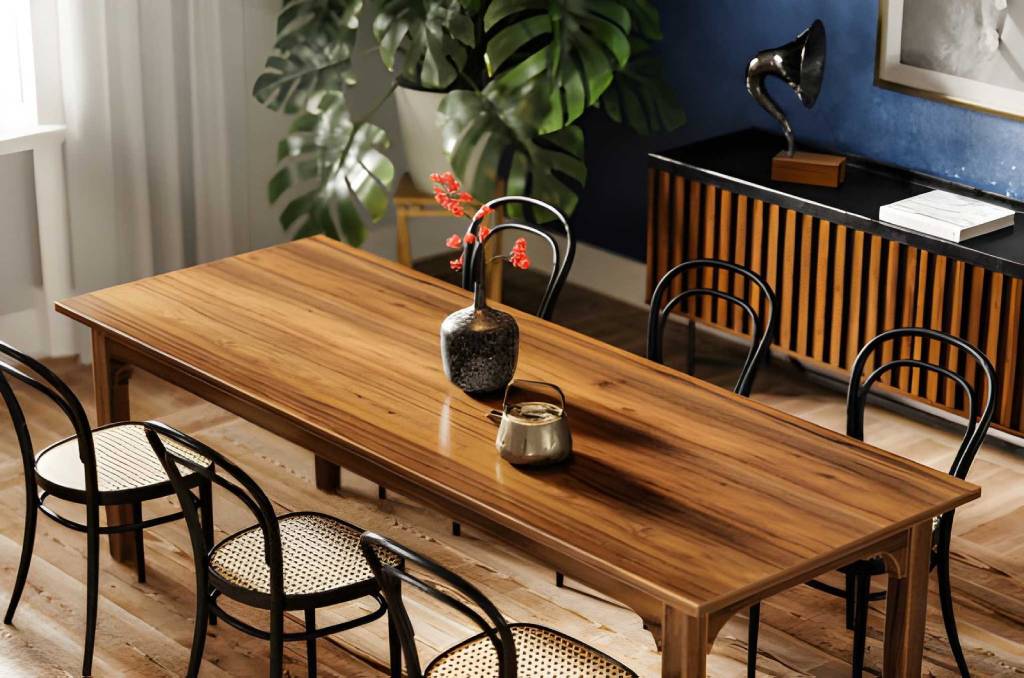
Most people pick a dining table based on looks alone.
They find something that matches the room, buy it, and move on. But a wooden dining table does something no glass or metal surface can it actually makes your home healthier, calmer, and more sustainable.
In 2026, that matters more than ever. Here’s exactly why wood belongs at the center of your home.
Table of Contents
How Wood Reduces Stress and Helps You Feel Calmer at Home
Wood has a measurable effect on your nervous system.
Research consistently shows that rooms with visible wood surfaces lower heart rate, reduce blood pressure, and improve heart-rate variability, a direct sign that your body is more relaxed.
This is explained by biophilic design, which is the idea that humans feel better when natural materials are part of their environment. Visible wood grain, with its organic lines and texture, signals safety and groundedness to the brain.
Participants in studies rated wood-finished rooms as significantly more inviting and comfortable than rooms dominated by synthetic materials.
Attention Restoration Theory takes this further.
Natural environments help the brain recover from mental fatigue, and wood-rich spaces work the same way indoors. A wooden dining table in your eating area creates a calmer atmosphere for family meals, better conversation, and genuine rest after a long day.
Exposure to wood environments is also linked to lower cortisol levels, your body’s primary stress hormone.
Field studies in simulated interiors found that people around wood surfaces showed reduced fight-or-flight responses and stronger rest-and-digest activity. That shift matters for your long-term health, even when wood is only present as a single surface, like a dining table.
Why a Solid Wood Table Outlasts Almost Every Other Option
A solid wood dining table is built to last for generations.
Unlike most furniture that gets thrown out after a decade, a well-made solid wood table can be sanded, refinished, and fully restored multiple times over its life.
Veneer tables, thin slices of wood over a cheaper core, don’t offer this.
Once the surface is damaged, your repair options are extremely limited. Solid wood is different. Scratches, stains, and worn areas can be removed by sanding back the surface and applying a fresh finish. This alone makes solid wood a smarter long-term investment.
The hardness of the wood matters too. Janka hardness measures how much force a wood can resist before denting, and different species perform differently for dining use.
| Wood Type | Janka Hardness (approx.) | Best Use | Appearance |
| Oak (white) | 1,360–1,460 lbf | Heavy-use dining tables | Prominent grain, warm tones |
| Walnut (black) | 1,010 lbf | High-end tables, accent pieces | Rich chocolate hues, smooth grain |
| Acacia (various) | 1,100–1,300 lbf | Casual dining, outdoor-style | Strong grain, natural character |
Oak and Acacia handle everyday spills and scratches exceptionally well. Walnut delivers a more refined, luxurious surface that suits homes where atmosphere comes first.
All three outperform synthetic materials in long-term durability.
How a Wooden Table Quietly Improves Your Indoor Air Quality
Most people don’t think about their furniture’s effect on the air they breathe. But it matters, especially around a dining table where your family spends time every day.
Traditional lacquers used on cheaper furniture often contain volatile organic compounds (VOCs), chemicals that off-gas into your indoor air and contribute to pollution.
Many modern wood furniture brands now use natural oil finishes made from plant-based oils and waxes. These are low-to-zero VOC, odor-free, and food-safe, making them a healthier choice for dining areas.
Wood also feels warmer to the touch because it has low thermal conductivity, typically between 0.05 and 0.2 W/m·K depending on the species. It doesn’t pull heat away from your hands the way metal, glass, or stone does. In cooler months, this makes a real difference in how comfortable and welcoming your dining space feels.
Wood also regulates indoor humidity naturally.
It absorbs and releases moisture in response to the air around it, which buffers the sharp swings in relative humidity that cause dryness, static, and discomfort. Studies show that wood-rich interiors can reduce extreme humidity fluctuations by up to 60%, meaning a more comfortable environment without constantly running mechanical ventilation.
Why Choosing Wood Is One of the Most Eco-Friendly Furniture Decisions You Can Make
Sustainability in furniture isn’t just about recycled packaging. It’s about what the material does over its entire life, from forest to your home to decades of use.
FSC-certified wood comes from responsibly managed forests with traceable supply chains from forest to finished product. Choosing FSC-certified dining tables reduces deforestation risk, supports fair labor practices, and backs communities that depend on sustainable forestry.
For 2026 buyers, certification is increasingly a deciding factor over uncertified alternatives.
Solid wood also stores carbon. Trees absorb carbon throughout their lives, and when that timber becomes furniture, the carbon stays locked in the material for decades.
A well-made wooden table functions as a long-term carbon store inside your home, reducing your household’s overall environmental footprint in a way that synthetic furniture simply cannot.
Reclaimed wood takes this further. These tables use timber salvaged from old barns, warehouses, and industrial structures.
Older wood is often denser and more stable than timber from younger trees. It also carries a unique character, knots, weathering, and patina that no new wood can replicate.
Environmentally, it reduces waste, demands no new logging, and supports a circular economy approach to furniture buying.
How Wood Adapts to Any Style You Want in Your Home
One of the most practical advantages of a wooden dining table is how effortlessly it adapts to changing design trends. Wood’s warm tones anchor a room without dominating it.
You can change cushions, lighting, tableware, and wall colors around it, and the table still works.
Neutral woods like oak and walnut sit comfortably within Japandi, Scandinavian, modern farmhouse, and industrial design schemes. They work as a timeless base while everything else in the room evolves around them.
This makes a wooden table a smarter buy than trend-specific materials that date quickly.
Wood also improves visually over time in a way that synthetic materials don’t. Instead of fading or looking worn, wood develops patina, subtle shifts in color and sheen that reflect years of use and care.
A well-maintained wooden table with a matte oil finish looks more characterful at ten years old than it did on day one. Designers in 2026 increasingly encourage embracing that natural evolution rather than chasing a surface that always looks brand new.
The Smarter Choice for Your Home, Your Health, and Your Future
A wooden dining table does more than hold plates.
It lowers your stress levels, improves your air quality, regulates humidity, stores carbon, and gets better with age, while synthetic alternatives wear out and get discarded.
Whether you choose FSC-certified oak for durability, walnut for warmth, or reclaimed acacia for character, you’re making a decision that pays off every single day.
Furniture that supports your health, adapts to your life, and lasts for generations isn’t a luxury; it’s just the smarter way to buy.